A New Call To Preserve Mezcal
A New Call
To Preserve Mezcal
Carmen López Torres
As Mexico revises NOM-070, the renewed debate over mezcal regulation invites a broader conversation about tradition, territory, and the living knowledge behind Mexico’s agave spirits.
One of the beautiful aspects of mezcal is its ability to offer a specific taste of place and tradition. But a new proposed version of the rules that govern mezcal production threatens to change that — and the window to weigh in is closing soon.
Coming from a food science background, I spent years studying consumer safety regulations. In Mexico, these rules are called NOMs (Norma Oficial Mexicana) — Mexico's equivalent of FDA or USDA regulations. These laws act as a foolproof guide for product development, dictating everything from cacao ratios in chocolate to bottling an agave spirit—all meant to ensure a producer won’t accidentally make a consumer sick.
But in the world of Mexican spirits, a NOM is much more than a safety manual. It’s the mandatory legal framework that regulates and certifies the authenticity standards required of a product with a Denomination of Origin (DO).
The Problem With The DO
Mexico’s DO system was modeled after European ones. In practice, though, DOs in Mexico have often been shaped as much by political and business agreements as by geography or tradition — meaning the system does not always benefit the small producers it is supposedly meant to protect. Mexico has 18 products with DO, four of which are agave-based, alongside other authentic beverages such as sotol and charanda.
Before receiving the DO, these beverages go through a complicated and expensive process supervised by several government agencies. This framework requires producers to justify their historical provenance, followed by a lengthy legal compliance process.
The existence of a regulatory council is necessary to verify compliance with each standard, which, in turn, must meet the requirements of the Mexican Accreditation Entity (EMA). This bureaucratic chain is controversial because these products have a history and tradition that long predate these agencies.
The DO has also been awarded in ways that have allowed certain business interests to shape the rules of the market, concentrating a significant share of its benefits among larger companies that are better positioned to distribute their products, fund promotional campaigns, and access international markets — as we have seen with tequila and, increasingly, mezcal. This creates a significant disparity between agave brands backed by transnational companies and independent producers operating outside the DO. Many of these producers make exceptional spirits, yet struggle to compete since they lack the marketing budgets big corporations have. The DO can be a tool for protection, but it can also be a barrier to entry for the very producers whose traditions it was intended to safeguard.
What Europe Can Teach Us
I have witnessed what a DO can accomplish when geography, tradition, and economic development reinforce one another.
In 2010, I traveled through several regions of France and Spain. That road trip changed the way I thought about geographical identity and food. I saw how pride and local identity could create entire economies around products. A small pepper, such as the Espelette pepper, can become a powerful economic and cultural symbol. Neighboring towns separated by only a few miles can showcase different geographical designations that enhance the value and identity of their products.
DOs work when the system protects the relationship between product, territory, people, and tradition rather than simply creating a commercial designation.
That distinction matters enormously for mezcal.
Updating the mezcal NOM
Every NOM must be submitted to a mandatory review every five years. A draft with the proposed changes is submitted for a trial period before being finalized into law. This period is critical. This year, the draft’s specific changes — permitting cross-region blending, loosening distillation and cooking requirements, and adjusting chemical limits — would weaken the protections that currently tie mezcal to a specific place, process, and tradition, unraveling what separates mezcal from an industrial agave spirit.
Terroir Blending
Draft 202X — which ends with an X because it is still uncertain whether it will be approved this year or next— proposes allowing mezcal blends not only from different batches but from different regions within the DO. So far, many transnational brands have blended only local batches, but cross-regional blending directly threatens the spirit's essence, which has traditionally reflected its origin and the hand that produces it. If passed, it would become legal to blend a batch from Oaxaca with a spirit from Durango.
This would go against the NOM’s own definition of mezcal: “ A liquid with an aroma and flavor derived from the species of maguey or agave used, as well as of the manufacturing process; diversifying its qualities by the type of soil, topography, climate, water, authorized producer, maestro mezcalero, alcoholic content, microorganisms, among other factors that define the character, sensations and organoleptic characteristics produced by each Mezcal.”
If mezcal’s richness comes from its regional identity, why would the NOM allow mixing terroirs? Mexico and its biodiversity should be celebrated, not blended.
New Distillation Standards
The proposed draft would make it optional to name the maestro mezcalero on the label, despite the central role these makers have played in shaping the mezcal category. Naming the person behind the spirit has helped build recognition around producers, whose work has become known well beyond their communities. Knowing who made your mezcal creates a connection to the person behind the bottle.
The draft also relaxes distillation requirements for artisanal mezcal by removing the requirement to use direct fire during distillation. This may seem like a technical change, but it has broader implications: altering how artisanal mezcal can be distilled could open the door to production methods increasingly removed from the traditional processes that have defined the category. In that sense, what appears to be a small regulatory adjustment could create another pathway toward industrialization.
At the same time, it puts a limit on the stills up to 700L— a traditional mezcalero usually uses stills from around 20 - 300 L, depending on the technique and town where they’re producing. Another questionable proposal is the vague legal definition of what ingredients and additives are allowed. If passed, we may start seeing more mezcal cristalino or mezcal with undisclosed additives.
There are also proposed changes to the limits for methanol, furfural, and what regulators call "superior alcohols" — essentially the secondary alcohols and compounds, beyond ethanol, that shape a spirit's aroma and mouthfeel. In the case of methanol, this change is significant because wild agaves tend to have slightly higher levels of this compound than cultivated ones. You can see the parameters on the actual NOM vs. the proposed ones in this table:
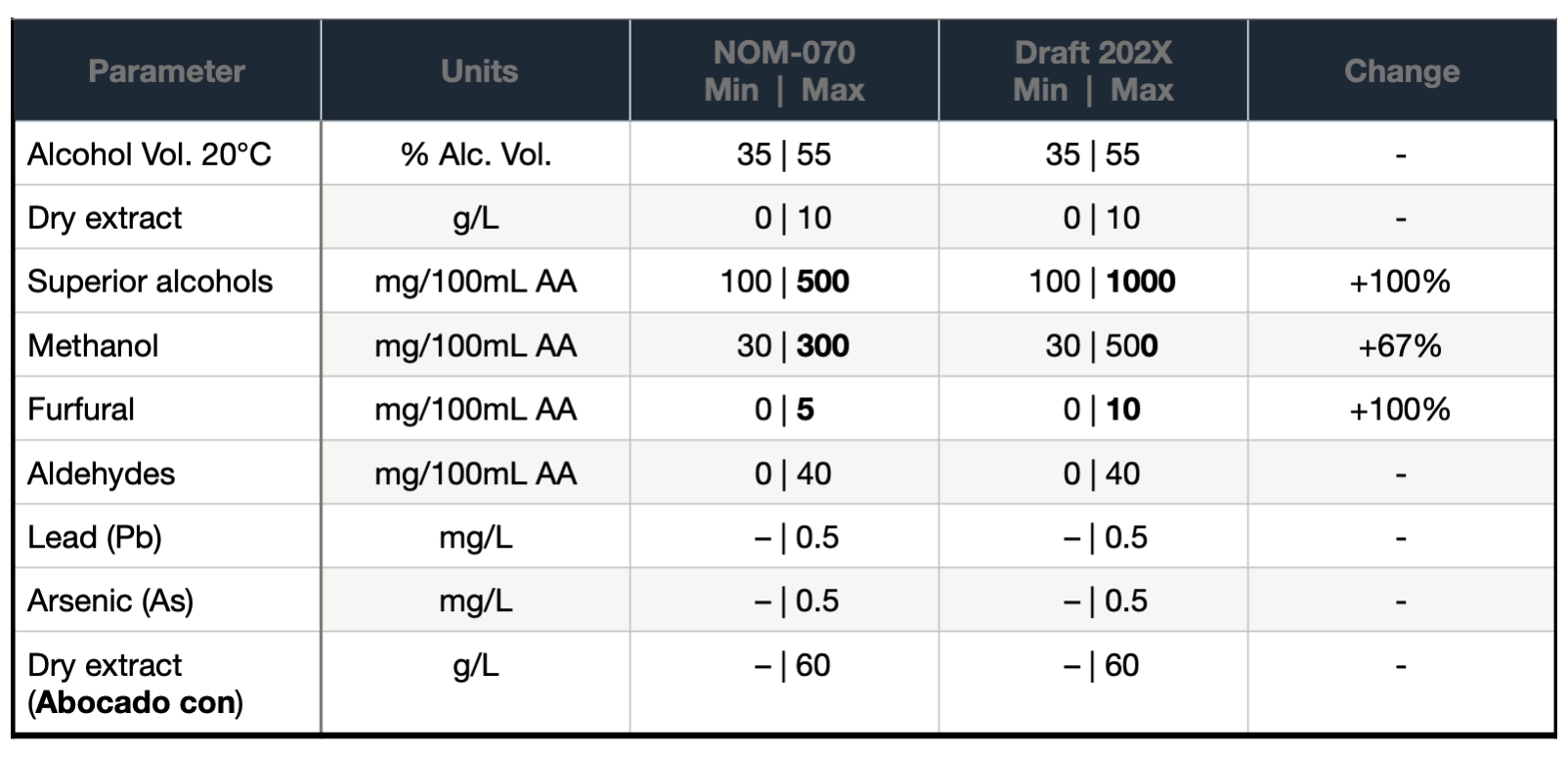
Table 1. Comparison of physicochemical specifications between NOM-070 and draft 202X
Methanol levels have been a topic of discussion between mezcaleros and researchers for years. Critics argue the current upper limit is stricter than comparable spirits require. European fruit brandies, for instance, can legally contain up to 700–1,000mg per liter.
Consequences of a New NOM
The proposed changes to the NOM could dramatically reshape the mezcal category, leaving consumers in the dark about how regions and production traditions differ—and, ultimately, what is actually in the bottle. The bifurcation of the category could also create an uneven playing field, allowing brands that use cheaper, more industrial methods to compete on price while still benefiting from the perception of artisanal production. For small traditional producers, the concern is not simply losing the word mezcal on a label; it is being pushed into a separate commercial category while competing for the same consumers.
Given the stringency and cost of the certification process, it is not surprising that some brands may choose to abandon the word mezcal and market their distillates abroad as agave spirits. That distinction matters because mezcal is more than a legal designation: it has become a category associated with place, tradition, craftsmanship, and premium quality. A producer’s decision whether to certify changes how the product enters the market and how its value is communicated to consumers. A producer can therefore remain economically connected to the same ecosystem while becoming administratively disconnected from the category that gives that ecosystem much of its identity and value. If more producers are forced to sell their distillates simply as agave spirits, the category could become increasingly fragmented. Consumers may encounter traditional, place-based spirits alongside more industrial products without a clear way to understand the differences. Over time, this could weaken the connection between the word mezcal and the traditional practices that have given the category its reputation — and make it harder for producers using slower, more expensive methods to justify the higher prices needed to sustain those practices.
The consequences extend beyond Mexico. Because the U.S. is the primary destination for agave spirits, the choices U.S. consumers, importers, distributors, bars and restaurants make can directly influence which production models remain economically viable in Mexico. If the market increasingly rewards lower-cost production while making traditional producers carry the greater regulatory burden, the effects will ultimately be felt not only in the bottle, but throughout the communities and supply chains that sustain mezcal.
What You Can Do
The deadline to submit feedback and audit Draft 202X closed on September 11th, and the subsequent discussion is still in the air. Consumers, operators, researchers, and educators must scrutinize the regulatory framework that shapes purchasing options in the agave spirits category. As consumers, we must collectively push back against rules that prioritize industrial consistency over agricultural heritage. There is proof our collective voice can have a direct impact. In 2016, TIP helped spearhead a binational effort, including academics, bartenders, and consumers, to strike down the proposed NOM-199, which sought to restrict use of the word agave to producers who participated in the certification process. So speak up, question the changing labels on your backbar, organize and make your voice heard before the discussion window closes.*
UPDATE: As of this article's publication, the Secretary of the Economy has implemented the “Ley de Infraestructura de la Calidad” (Quality Infrastructure Law), which regulates the Normas Oficiales Mexicanas. As a result, the current discussions around NOM-070 have been put on hold. Please continue to follow Carmen (@mezcaldelcarmen) and Tequila Interchange Project to stay up to date on the latest developments.